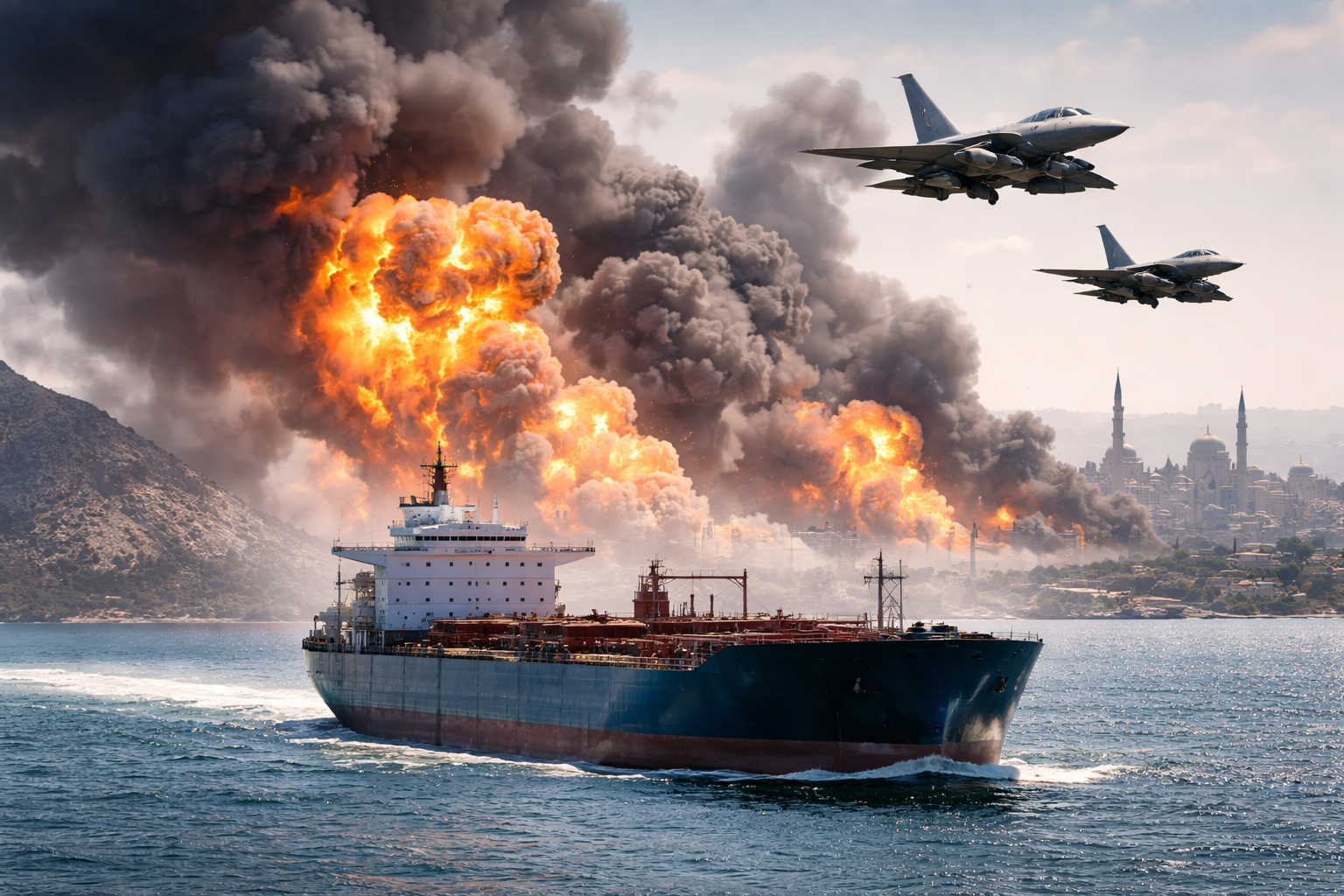
Trading markets close on Friday night, and Saturday begins with a new global conflict.
The United States and Israel have launched coordinated military strikes across Iran, targeting military, missile and nuclear-linked infrastructure.
President Donald Trump has framed the operation as the elimination of “imminent threats,” but his own public statements and subsequent commentary reveal a deeper plan.
They reveal a campaign that blends military degradation, nuclear rollback, and open calls for regime change.
And the economic implications are severe and will dictate much of the debate over where to invest as the new week begins.
How did we get here
The current confrontation sits on decades of hostility. The 1953 coup, the 1979 revolution and hostage crisis, the nuclear dispute that led to the 2015 JCPOA deal and its US withdrawal in 2018 all built a framework of distrust.
Since 2018, Iran has expanded uranium enrichment to levels the International Atomic Energy Agency says are close to weapons grade, while Washington has reinstated heavy sanctions under a “maximum pressure” policy.
Tensions accelerated in 2025 when the US struck Iranian nuclear sites, followed by a brief ceasefire.
On Saturday, February 28th, explosions were reported in Tehran, Isfahan and Qom.
Iran responded with missile and drone strikes against Israel and US bases in the region.
Israeli airspace closed and a state of emergency was declared.
President Donald Trump said the objective was to eliminate “imminent threats” and called on Iranians to rise up against their government.
His language went further than a narrow military aim. It blended nuclear rollback, missile destruction and regime change.
That mix tells investors that the end state is uncertain, and uncertainty is what drives rapid reassessment of where to invest.
What does the US really want
In an eight-minute address, Trump listed several goals.
He spoke of dismantling Iran’s nuclear programme, destroying missile production, neutralising naval capacity and ending support for regional proxies.
He also urged the Iranian people to take control of their country.
The reality is that without regime change, most of these aims would be temporary. Nuclear facilities can be rebuilt. Missiles can be reassembled.
Inspectors can be expelled. Air power can damage infrastructure, although it has rarely toppled governments on its own.
What brings leverage to the US is that Iran enters this confrontation in a weak economic position.
GDP per capita has stagnated since 2007. The rial has fallen from around 36,000 per dollar in 2016 to close to 1.6 million recently. Inflation has hovered near 40 per cent.
According to official data, about a third of the population lives below the poverty line. Protests in late 2025 and early 2026 were met with a severe crackdown.
Economic fragility may increase political pressure, while it does not eliminate the regime’s ability to retaliate.
A balance that markets must consider when deciding where to invest when the bourses open on Monday.
Why oil is the real battlefield
For markets, the centre of gravity is not Tehran but the Strait of Hormuz.
Around 13 million barrels per day of crude moved through the strait in 2025, roughly 31% of global seaborne flows.
About a fifth of the total global oil supply passes through that narrow channel between Oman and Iran.
That is why investors describe this as a chokepoint story rather than a production story. Venezuela produces around 800,000 barrels per day. Iran sits next to a corridor that moves more than ten times that amount.
Economists say a limited conflict could lift Brent toward $80 a barrel from $73. A longer conflict that disrupts supply could push prices toward $100.
A direct attempt by Iran to block Hormuz would create a far larger shock. Even before the strikes, crude had risen more than 2% on reports that talks in Switzerland had failed to make progress.
OPEC+ meets this weekend and may raise output quotas, perhaps by more than the 137,000 barrels per day discussed in recent reports.
Additional supply can soften the blow, although it cannot replace a major chokepoint overnight.
How markets are likely to react
Investors expect a classic risk-off pattern. Oil higher.
Equities are lower by one to two per cent at the open. US Treasury yields are down by five to ten basis points. The dollar and gold are stronger. The Japanese yen bid.
In June 2025, when Israel struck Iranian nuclear sites, equities sold off and then recovered once it became clear that Hormuz remained open.
Some managers note that positioning has already turned defensive.
Oil has firmed in recent weeks and demand for Treasuries has increased. That may cushion the first move.
The duration of the campaign will determine whether this remains a short shock or becomes a broader repricing.
It will also ultimately clarify where to invest once the initial volatility fades.
Israel’s own economy offers a recent reference point. During last year’s 12-day conflict, GDP fell 1.1% quarter on quarter in the second quarter.
A longer campaign would weigh on output through lower activity, higher security spending and weaker investment.
Asian markets may be more sensitive than others.
Many economies in the region depend heavily on imported energy and stable shipping routes.
A sustained spike in oil prices would feed directly into trade balances and inflation.
What happens if the regime falls
There is also a longer term scenario that investors rarely price in at the start of a war.
A February 2026 study by the Vienna Institute for International Economic Studies estimated that lifting EU sanctions alone could raise Iran’s real GDP by 82% in the long run.
Germany’s GDP would rise by about 0.32% and the EU’s by 0.33 percent through higher exports and lower energy costs.
Combined with productivity catch up toward countries such as Turkey or South Korea, Iran’s GDP could expand by more than 200 percent.
The same study estimated that restoring Iranian oil production could reduce global oil prices by 6-15% over time.
Entry into LNG markets would add further downward pressure on gas prices in Europe.
That upside requires a stable transition and reintegration into global markets.
A disorderly collapse would create the opposite effect through migration flows, supply chain disruption and regional instability.
For now, traders are watching tanker traffic and satellite images more closely than speeches.
The near term path runs through Hormuz.
The longer term path runs through Tehran’s political system. Investors need to price both.
The post US, Israel strikes on Iran send oil prices higher, markets into risk mode appeared first on Invezz
