Germany’s economy entered 2026 in a different place than it was a year ago.
Risks of contraction are fading, inflation has returned to target, and business sentiment is improving.
But growth remains weak, the labour market is softening, insolvencies are elevated, and the recovery is heavily reliant on public spending.
What matters for Europe’s largest economy now is whether it can transition from stabilisation to durable expansion, because that’s what the rest of the world expects from it.
Has Germany finally left stagnation behind?
After expanding by just 0.2% in 2025, Germany narrowly avoided a third year without meaningful growth.
The final quarter brought relief, as GDP rose by 0.3% quarter-on-quarter, supported by household consumption, government spending and a rebound in construction and equipment investment.
The federal government now expects growth of around 1.0% in 2026, slightly below earlier projections. Private forecasts range between 0.6-1.3%.
Bloomberg Economics estimates annual growth closer to 0.8%, with the pace gradually improving toward the second half of the year.
A closer look at the composition of growth reveals the real story.
A large share of the expected expansion comes from debt-financed investment in infrastructure and defence after Germany relaxed its debt brake.
Public investment is projected to contribute roughly two-thirds of a percentage point to growth this year. That leaves only a small margin for private demand to carry the recovery on its own.
Are industry and exports coming back?
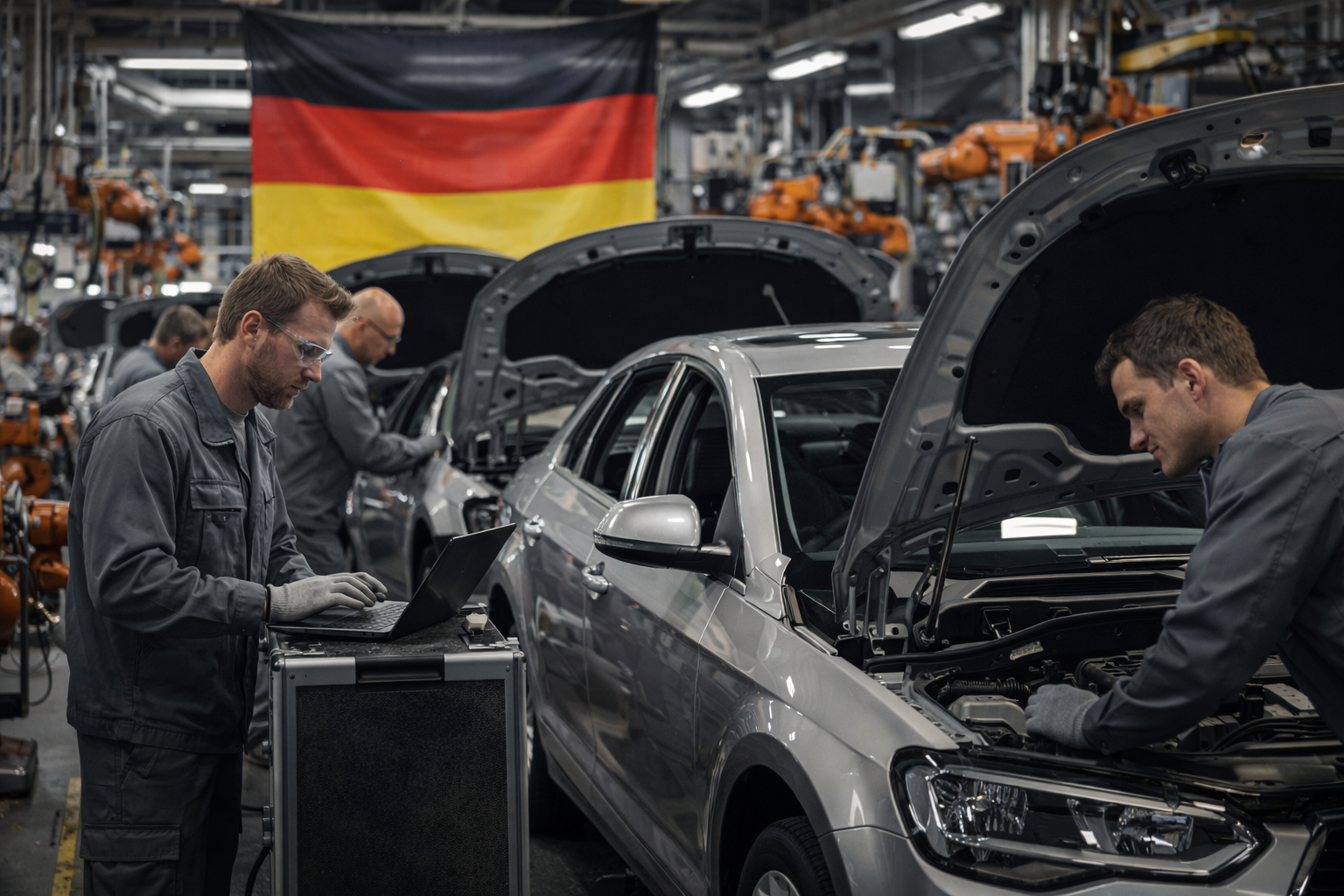
Manufacturing has shown tentative signs of life.
Factory orders rose 7.8% month on month in December, the strongest jump in two years. In the fourth quarter, orders were nearly 10% higher than in the previous quarter.
Purchasing managers’ surveys indicate that manufacturing is expanding again for the first time since 2022.
Yet production data remain uneven.
Industrial output fell 1.9% in December. Exports grew by 4% in the same month, although imports also increased and the annual trade surplus narrowed to €202.8 billion from €244.9 billion in 2024.
China remains Germany’s largest trading partner with a turnover of €253 billion in 2025, followed by the United States.
However, the balance of the relationship has changed. German exports to China have weakened while Chinese exports to Germany have risen.
German investment in China reached a four-year high.
Chancellor Friedrich Merz acknowledged this new reality during his visit to Beijing.
“China has risen to the ranks of the major powers,” he said before departing.
The remark reflects a broader reassessment in Berlin.
Germany is more exposed to Chinese supply chains than it was a decade ago, particularly in electric vehicle components and critical materials.
That exposure is not just a geopolitical headline, as it feeds directly into earnings volatility for industrial firms.
What does inflation tell us ahead of the ECB decision?
Inflation no longer dominates the debate. Germany’s EU harmonised inflation rate eased to 2.0% in February from 2.1% in January, according to provisional data.
Core inflation stood at 2.5%.
Energy prices and a stronger euro have helped cool headline figures.
Across the euro area, inflation fell to 1.7% in January.
The European Central Bank has kept its deposit rate at 2.0% and signalled that policy is in a good place.
Markets expect rates to remain unchanged at the upcoming meeting.
For Germany, the transition in inflation dynamics changes the policy risk profile.
Twelve months ago, the concern was overheating prices. Now the risk is that growth stalls before private investment gains traction.
The ECB faces a difficult calibration. Cutting too early could reignite services inflation, while waiting too long could tighten financial conditions into a fragile recovery.
German bond yields have stabilised, and equity valuations reflect the view that rate cuts will come later this year rather than immediately. That expectation underpins current market resilience.
Why is the labour market still soft?
The labour market has not shared the recent improvement in sentiment.
In January, unemployment rose to 3.085 million, pushing the jobless rate to 6.3%.
Although seasonal factors explain part of the increase, vacancies have fallen compared with a year earlier and business surveys point to cautious hiring plans.
Corporate insolvencies climbed 8.3% in 2025 to 23,900 cases, the highest level since 2014.
Micro enterprises accounted for more than 80% of the total, and manufacturing and retail saw double-digit increases. These figures highlight that structural adjustments are still underway.
Real wages have started to recover, rising 1.9% in 2025 after a stronger rebound in 2024. Yet purchasing power remains below its pre-pandemic level.
Households have become more selective in spending, which limits the strength of consumption-driven growth.
How does the stock market fit into this picture?
German equities have held up better than domestic growth would suggest.
The DAX index is heavily weighted toward multinational firms that generate much of their revenue outside Germany.
As global trade stabilises and inflation recedes, those companies benefit from improved margin visibility and lower financing costs.
However, the market’s resilience rests on several assumptions. One is that US tariff tensions will not escalate. Another is that China’s slowdown will remain contained.
A third is that ECB policy will ease gradually without triggering renewed inflation concerns.
If any of those assumptions weaken, earnings forecasts for industrial and export-oriented firms could face renewed pressure.
Valuations are not stretched, but they are no longer cheap relative to the macro backdrop. Investors are effectively pricing in a slow but steady improvement rather than a sharp rebound.
What should investors focus on in the second half of 2026?
Germany has moved from contraction to stabilisation.
That transition is visible in GDP data, business surveys and inflation readings. Yet the recovery remains heavily supported by fiscal policy and vulnerable to external shocks.
The key test will come later this year. If private investment begins to accelerate alongside public spending, growth could approach the upper end of forecasts.
If industrial output fails to follow the improvement in orders, momentum may fade again.
Germany’s economy is no longer in decline, but it has not yet rebuilt a strong internal engine.
For investors, the opportunity lies in identifying which sectors can convert public stimulus and global demand into sustainable earnings growth, rather than assuming that a return to 1 per cent growth marks the start of a broader upswing.
The post Germany’s economy surprises, but don’t call it a boom yet appeared first on Invezz
