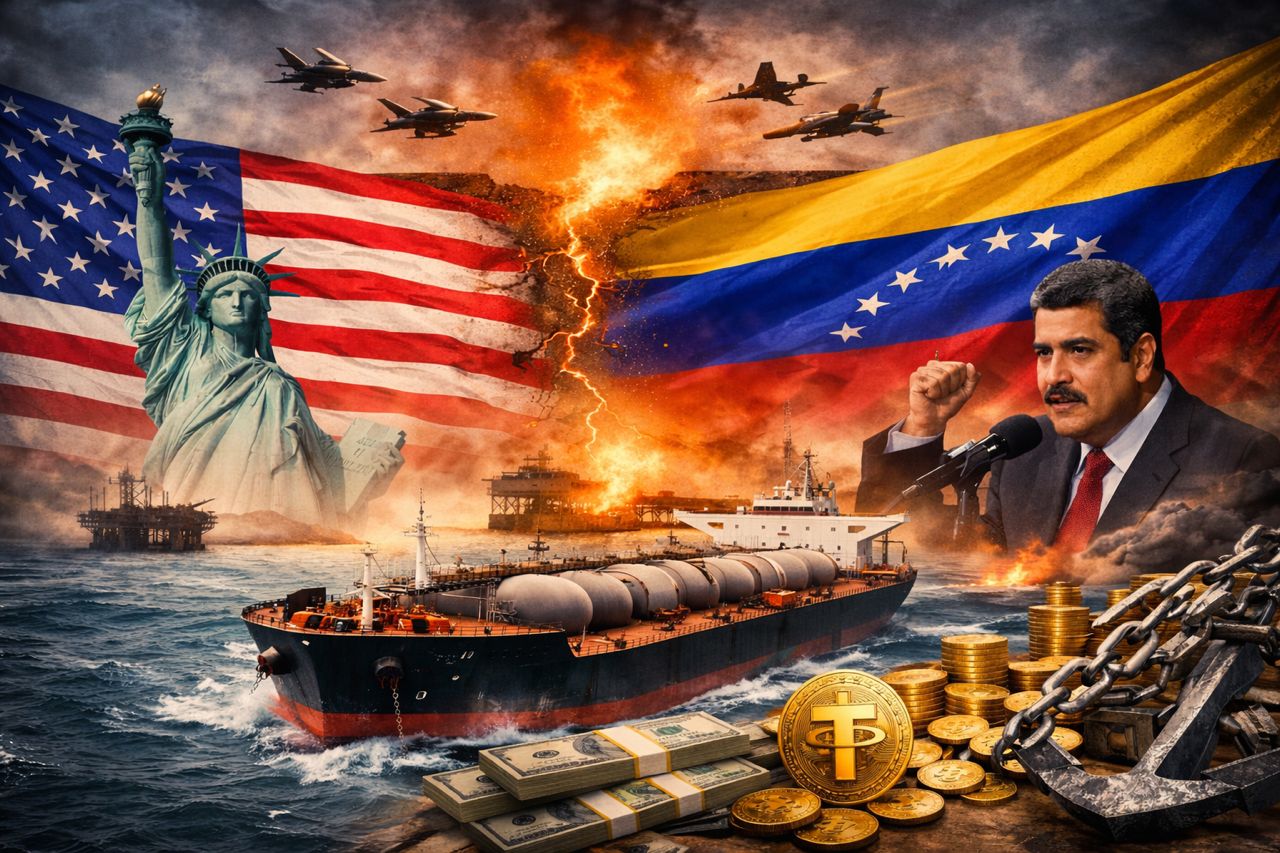
Despite official claims of recovery, Venezuela is heading toward 2026 burdened by deep structural weaknesses and rising uncertainty.
Economist Aldo Contreras and political analyst Pablo Quintero told Invezz the country remains trapped in a prolonged downturn that began more than a decade ago. Venezuela’s gross domestic product peaked at over $460 billion in 2012.
The International Monetary Fund now estimates GDP will total just over $109 billion in 2025—a nominal contraction of roughly 75%.
Contreras describes the current moment as part of an extended economic cycle marked by lost output, weak investment, and persistent fragility.
Politically, risks are intensifying.
Quintero said Venezuela’s outlook is increasingly defined by escalation, confrontation, and unpredictability, particularly in its relationship with Washington.
Those tensions sharpened this month after President Donald Trump said the US would begin seizing sanctioned oil tankers linked to Venezuela—an action that followed within days.
Writing on Truth Social on December 16, Trump said he had ordered “a total and complete blockade of all sanctioned oil tankers entering or leaving Venezuela.”
Caracas condemned the move as an attack on its sovereignty, pledging a response without specifying countermeasures.
Venezuela holds the world’s largest proven oil reserves and produces about one million barrels a day.
But US sanctions have pushed state oil company PDVSA to sell much of its output at steep discounts to Chinese refiners, effectively sidelining the country from global energy markets.
While the measures appear designed to pressure President Nicolás Maduro’s government, analysts warn they risk further straining an economy already under severe stress—most acutely for ordinary Venezuelans.
A fragile macroeconomic outlook
While Venezuela’s government has highlighted growth figures for 2024 and 2025, Contreras says the numbers fall far short of signalling a genuine recovery when measured against historical benchmarks.
On a per-capita basis, nominal GDP has fallen from about $15,500 to roughly $2,500 today. Looking ahead to 2026, macroeconomic indicators remain fragile.
Independent estimates put inflation as high as 600%, the bolívar is expected to keep depreciating, and a wide foreign-exchange gap continues to distort prices and raise costs across the economy.
The spread between the official exchange rate and parallel markets exceeded 60% in 2025, based on daily central bank data. The divergence has inflated corporate expenses and disrupted pricing throughout supply chains.
If current trends persist, the exchange rate could reach 450 bolívares per dollar by 2026, raising the risk of a renewed bout of hyperinflation.
Such a scenario would further erode purchasing power in a country where more than 70% of the population earns less than $50 a month.
Inequality and a survival economy
Contreras says inequality has reached unprecedented levels.
Once among Latin America’s most egalitarian societies, Venezuela now exhibits stark income disparities. Only about 30% of the working population earns more than $300 a month, while just 6% makes over $1,000.
The result is what Contreras describes as a “survival economy,” in which most households struggle to meet basic needs.
Tax revenues have risen—from $5.6 billion in 2024 to a projected $11 billion in 2025—and oil output has increased following the partial easing of Chevron-related sanctions.
But those gains have not translated into higher wages. The minimum monthly salary remains about $0.30, or 130 bolívares.
Tight monetary conditions have compounded the strain. A reserve requirement of roughly 73% and limited access to bank credit have constrained lending and suppressed broader economic activity.
Commerce without development
The existing growth is largely concentrated in trade and services. Small businesses—bakeries, bodegones, hardware stores and mini-markets—have expanded, supported in part by remittances estimated at more than $4 billion a year.
By contrast, productive sectors such as manufacturing, construction, agriculture and livestock remain largely dormant. Construction activity, for example, has been effectively paralysed for more than a decade.
The imbalance has widened regional disparities. Urban centres show pockets of consumer spending and housing shortages, while rural and peripheral areas face deteriorating public services.
Sales of an estimated 34,000 imported vehicles in 2025, according to industry estimates, stand in contrast to the absence of long-term mortgage financing.
Sanctions, crypto and oil risk
Contreras says the selective easing of sanctions has done little to unlock sustainable growth.
“Sanctions have been partially relaxed, but without legal certainty, credit or infrastructure, alternative sectors simply don’t take off,” he said.
Tourism, banking and construction hold potential but remain constrained by political risk and capital shortages.
One adaptation has been the increased use of cryptocurrency. With limited access to formal foreign-exchange markets, state oil company PDVSA has reportedly accepted stablecoins such as USDT for some oil transactions.
“The use of stablecoins like USDT and USDC has become a relief valve in the absence of official foreign-currency supply,” Contreras said.
Blockchain analytics firm Chainalysis estimates Venezuela transferred about $44.9 billion in cryptocurrency over the past year, underscoring the growing role of digital assets as a parallel payment system.
The oil sector, however, remains the biggest source of uncertainty. Recent statements by US President Donald Trump on possible blockades of sanctioned oil tankers threaten 2026 growth projections that currently assume GDP expansion of about 6.5%.
“If these measures turn into a de facto oil embargo in the Caribbean, Venezuela would lose almost all of its foreign-currency income,” Contreras said.
Oil exports account for more than 83% of hard-currency inflows.
Such an outcome could trigger a renewed cycle of hyperinflation, currency collapse and economic contraction similar to that seen between 2016 and 2018. Even the modest stabilisation recorded in 2025 could quickly unravel.
Politics of escalation
Political analyst Pablo Quintero says Venezuela’s outlook toward 2026 is increasingly shaped by escalation, confrontation and uncertainty.
Rather than moving toward negotiation or de-escalation, the coming months—particularly early 2026—are likely to intensify internal and external tensions. Venezuela, he argues, is entering a phase in which conflict becomes the organising principle of political power.
If international pressure increases, Quintero expects the government to reinforce its narrative of an external enemy to consolidate its base and maintain internal cohesion.
The approach feeds a cycle of mobilisation, propaganda and ideological alignment within the ruling Socialist Party.
Recent remarks by Trump and US Secretary of State Marco Rubio portraying pressure on Venezuela as effective have added to the atmosphere.
Quintero says the strategy relies less on direct military action than on psychological, economic and diplomatic coercion.
Oil remains a central lever. Measures such as tanker seizures, shipping restrictions and tighter maritime controls are designed to disrupt exports and limit the involvement of partners such as China and Iran.
“What we’re seeing isn’t conventional warfare, but a strategy of maximum pressure through blockades, seizures and influence campaigns,” Quintero said.
The domestic consequences could be severe. Fuel shortages as early as the first quarter of 2026, reduced investor confidence, and deeper isolation from global markets are among the risks. Aviation could also be affected if airspace restrictions tighten.
Dialogue stalled
Diplomatic talks appear effectively frozen, Quintero said, with no meaningful negotiations advancing. Support from allies such as Russia and China has been cautious and limited.
Trump’s rhetoric has further inflamed tensions. One statement asserting broad US influence over Venezuela’s oil sector triggered regional backlash. Quintero says the message was aimed less at Caracas than at Beijing, Tehran and oil-importing nations.
Paradoxically, such rhetoric may bolster President Nicolás Maduro domestically, reinforcing the government’s anti-US narrative and weakening an already fragmented opposition.
As 2026 approaches, Venezuela faces a convergence of external pressure, internal propaganda and stalled diplomacy.
Both analysts warn that without political dialogue and structural economic reforms, the country risks remaining trapped in stagnation, with rising instability ahead.
The post Why 2026 could be another tough year for Venezuela’s economy under Maduro? appeared first on Invezz
