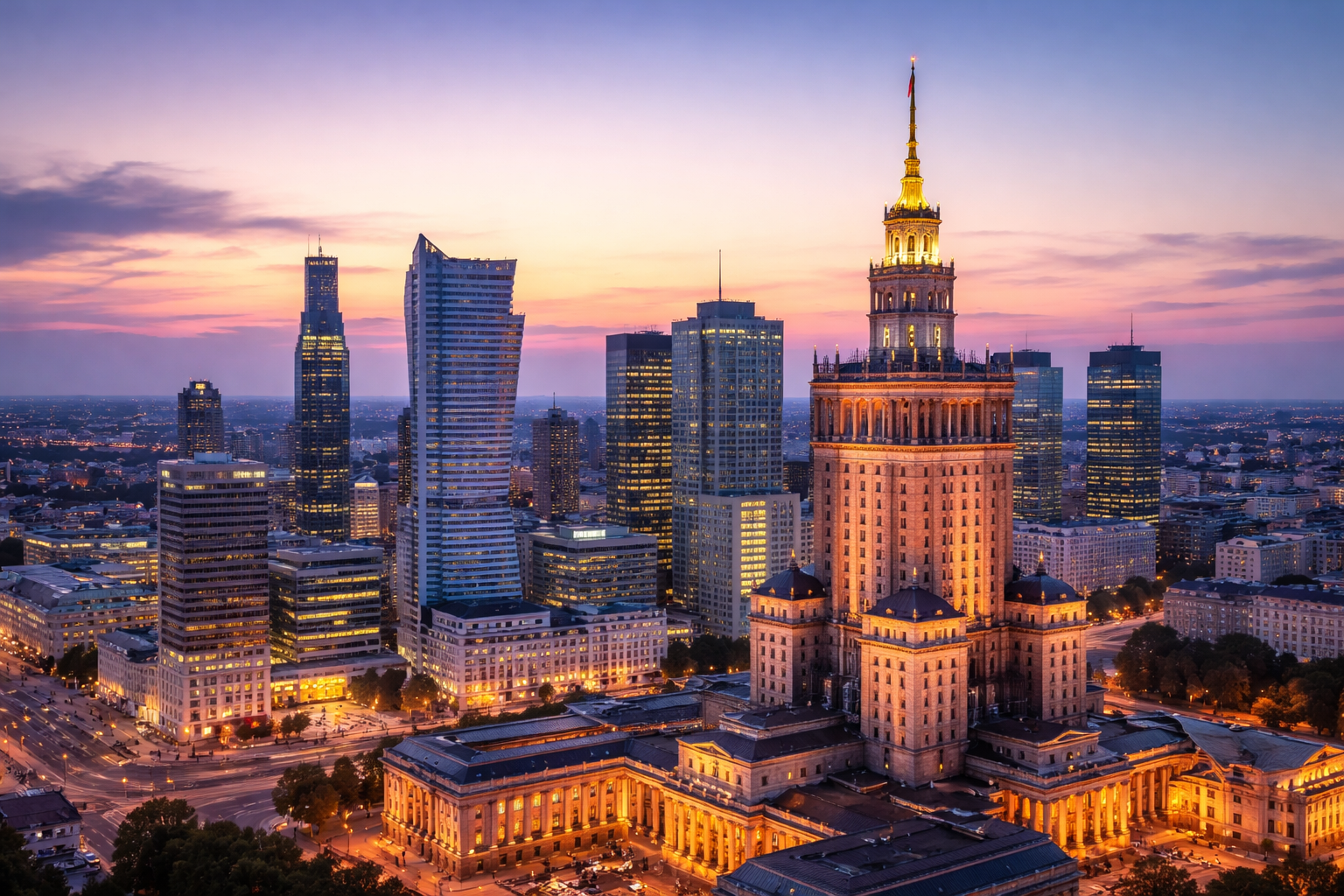
Poland’s economy crossed the $1 trillion mark last year, placing it around 20th in the world by nominal output. The OECD expects growth of roughly 3.4% this year, which is the fastest reading in the European Union.
All of this is happening while Europe’s current largest economy is flirting with stagnation. This is exactly why investors are turning their attention away from Germany and are looking towards the East.
How did Poland’s economy rebuild after communism
When communism collapsed, Poland was able to recover rather quickly. Prices were liberalised, state companies were privatised, trade was opened, and institutions were rebuilt.
The plan was to feel the pain early, but macro stability was to come sooner than in other European nations.
And it worked. Inflation was brought under control, and the banking system was strengthened.
Unlike many peers, Poland avoided a prolonged collapse.
Poland’s EU accession in 2004 locked in that progress. Structural funds financed roads, rail links, and urban upgrades, and German manufacturers integrated Poland into their supply chains.
Over time, the country became a core part of European industry rather than a peripheral workshop.
Between 1990 and 2020, Poland was one of the fastest-growing major economies in the world, second only to China in cumulative expansion over that period.
It was also the only EU member to avoid recession during the 2008 financial crisis.
The key here was the currency, złoty, as Poland kept its own and didn’t adopt the euro.
During global shocks, the exchange rate could adjust, supporting exports when demand weakened.
Why did services and outsourcing accelerate growth
After manufacturing came services. Poland became Europe’s leading hub for business process outsourcing in IT, finance, and human resources.
The sector now employs close to half a million people and accounts for around 6% of GDP.
Cities such as Kraków became white-collar clusters, with unemployment falling to around 2% and wages rising rapidly.
This was a powerful convergence engine. Skilled workers earned Western contracts at a lower cost.
Foreign companies expanded operations in Poland rather than in Asia because of language skills, EU law, and proximity to headquarters.
However, success brought its own tension. Poland recorded one of the fastest wage increases among advanced economies since the 1990s.
Kraków salaries recently moved above Warsaw and around a quarter above the national average. So the country is no longer cheap.
At the same time, artificial intelligence began to automate routine back-office work.
In 2025, companies in Kraków announced more than 4,000 planned layoffs, a sharp increase from the year before, mainly in data processing and accounting roles.
Office vacancy rates climbed toward 19%.
Poland’s economy is now at a stage where labour arbitrage is fading, and productivity must take over.
Can Poland avoid the euro and still thrive?
Despite its EU membership, Poland has still not adopted the euro. Finance minister Andrzej Domański recently told the Financial Times that the case for joining had weakened because Poland’s economy is outperforming most euro area members.
Growth is stronger, unemployment is among the lowest in the bloc, and the złoty has appreciated since 2023.
Fiscal numbers complicate the debate. The budget deficit is above 6% of GDP, far from the Maastricht threshold of 3% required for euro entry, while public debt is rising toward 70% of GDP.
For now, monetary sovereignty offers flexibility while the economy remains in transition.
The government argues that any decision on the euro is political and timing rests with Warsaw.
However, Poland retains tools that euro members do not.
Why is Poland’s economy investing in Germany
The more symbolic change is outward investment. In 2025, Polish companies announced a record 22 acquisitions in Western Europe, with 9 of them being in Germany, according to Bloomberg data.
Firms such as Wirtualna Polska, Spyrosoft, and Pesa have bought established German businesses in travel, IT services, and rail manufacturing.
Parcel locker operator InPost expanded across Western Europe through acquisitions and is now valued at nearly eight billion euros in a potential buyout.
Two decades ago, German capital flowed east. Today Polish capital moves west.
German GDP per capita was more than 4x Poland’s when the country joined the EU. It is now roughly double.
German growth last year was around 0.2%, while Poland expanded by about 3.6%.
This does not mean Poland is overtaking Germany in scale, but it definitely indicates maturity. Companies accumulated capital at home and are now deploying it abroad to gain market share.
What risks could slow Poland’s economy
The strengths are clear, but so are the risks. Demographics are the most serious. Poland’s fertility rate is close to 1.1 children per woman, one of the lowest in the world.
United Nations projections suggest the population could shrink by several million by mid century.
Fewer workers will have to support more retirees. Without automation or immigration, potential growth will fall.
Public finances are stretched by defence and infrastructure spending. Poland now spends close to 5% of GDP on defence, the highest share in NATO.
That supports domestic industry and secures the eastern flank, yet it also widens the deficit. The government is betting that growth will outpace debt accumulation.
There is also the German link.
Germany remains Poland’s largest trading partner by a wide margin. If German industry continues to struggle, Polish exporters will feel it. Supply chains are deeply intertwined.
Finally, the service sector must upgrade. Artificial intelligence will remove routine roles, but it can also lift productivity in higher-value work.
Universities have begun expanding AI programmes and research centres. Whether that translates into scalable innovation will determine the next phase.
Poland’s economy has already completed one transformation, from post communist laggard to European growth engine.
The next decade will show whether it can turn that growth into a sustained developed status.
The capital is there. The ambition is visible. What remains is execution in a world where labour is no longer the main advantage.
The post Poland’s $1T economy: Why investors are shifting focus from Germany to Poland appeared first on Invezz
