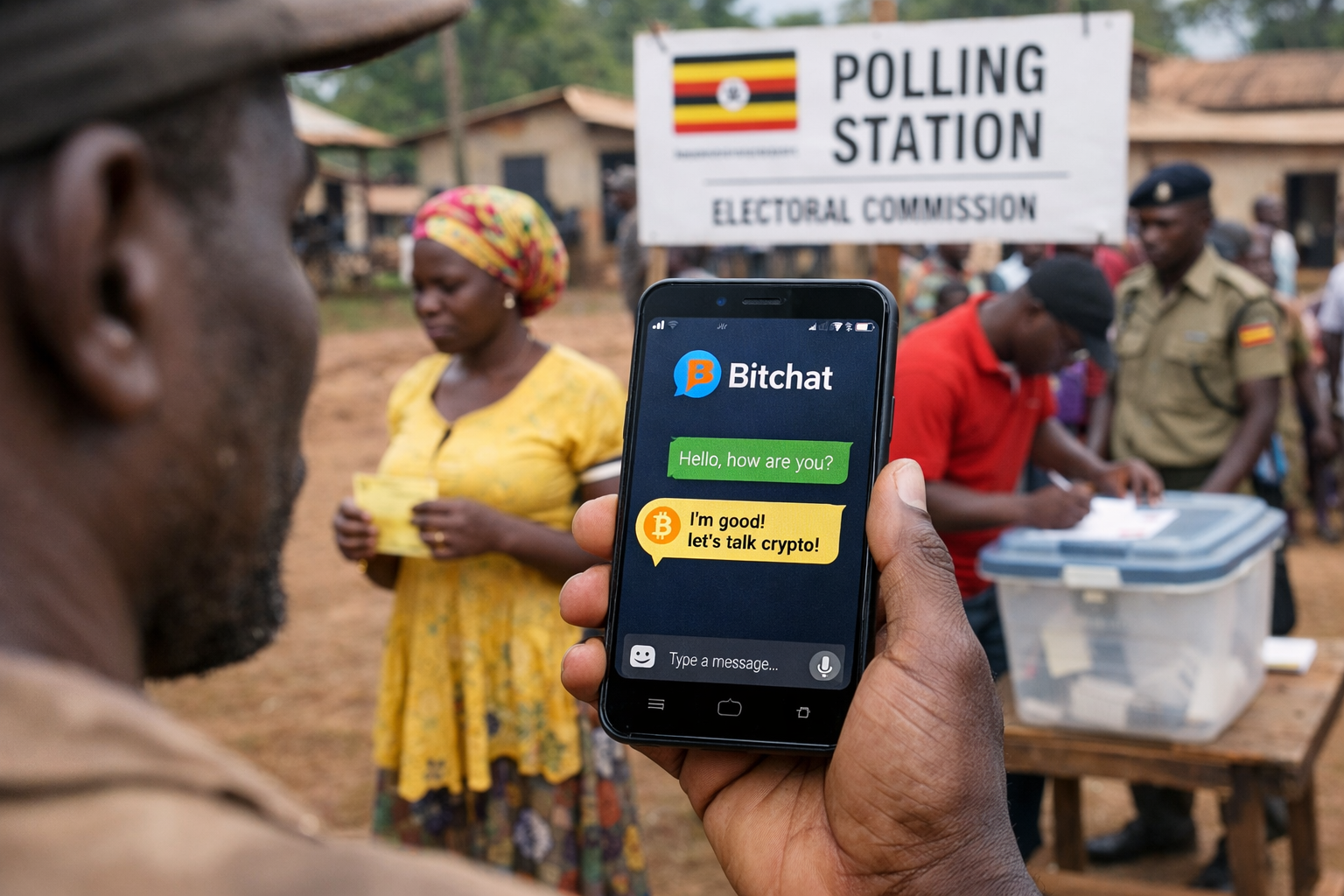
Uganda’s presidential election week has been marked by a sharp rise in the use of Bitchat, a decentralized Bluetooth-based messaging app, as citizens scramble for ways to stay connected amid a government-imposed internet blackout.
The Uganda Communications Commission (UCC) officially pulled the plug on internet access at 6:00 p.m. local time on Tuesday, just two days before voters head to the polls.
This is the third consecutive election cycle where authorities have disabled online access, a move officials claim helps curb misinformation during politically sensitive periods.
Uganda’s history of election-period shutdowns stretches back nearly a decade.
In 2016 and again in 2021, President Yoweri Museveni’s government enacted multi-day internet blackouts during elections, citing national security and public order.
But for many Ugandans, the blackout is seen less as a protective measure and more as an attempt to obscure electoral processes.
Critics argue the absence of connectivity undermines transparency and stifles the ability of voters and poll watchers to communicate and share real-time results.
Bitchat secures No. 1 spot on app stores
Against this backdrop, Bitchat has soared to the top of Uganda’s app store rankings on both the Apple App Store and Google Play. (See below.)
Bitchat ranking on the Apple App Store. Source: Appfigures.
The encrypted messaging platform, launched by Jack Dorsey in 2025, is built to function without internet access, relying instead on a Bluetooth mesh network where each device relays messages to others nearby.
This peer-to-peer infrastructure has made it particularly useful in blackout zones, where conventional messaging apps fail.
Bitchat’s popularity in Uganda began building in late December after opposition candidate Bobi Wine publicly urged his supporters to install the app in preparation for a possible communications clampdown.
Data posted by Bitchat developer Calle on Jan. 5 indicated over 400,000 downloads in Uganda alone, a number that has likely grown further following Tuesday’s shutdown.
I was about to celebrate 1M bitchat android downloads but uganda’s opposition leader bobi wine jinxed it ✊
The UCC’s executive director, Nyombi Thembo, had previously assured the public that there would be no internet disruptions.
“Why would you use Bitchat when there is internet, internet will be there,” he stated last week.
He also dismissed the app as inconsequential and claimed the government possessed the technical capacity to disable it.
“We know how it can be made not to work. Don’t be excited by Bitchat, it’s a small thing,” Thembo said.
However, Bitchat’s open-source contributors disputed those claims, arguing that Bitchat’s decentralised design, which lacks central servers or user accounts, makes it difficult to shut down or censor.
Using the app requires no SIM cards, phone numbers, or emails to operate, and includes features like panic wipes and traffic obfuscation to safeguard user privacy during volatile conditions.
Bitchat’s role as a tool against censorship
Bitchat’s emergence in Uganda mirrors its role in several other countries that have experienced civil unrest or infrastructure failures.
During the Nepal protests last year, the app became a digital lifeline after social media platforms were restricted by the government.
Within just days, daily downloads surged from a few thousand to nearly 50,000, helping organisers coordinate marches and share information.
Similar waves of adoption were seen in Madagascar during political protests, and in Indonesia, where demonstrators turned to the app to maintain anonymity and evade surveillance.
Most recently, during Hurricane Melissa in the Caribbean, Bitchat saw widespread use in Jamaica as wind damage knocked out cellular and internet infrastructure.
The post Bitchat tops Uganda app stores as election internet blackout drives use appeared first on Invezz
