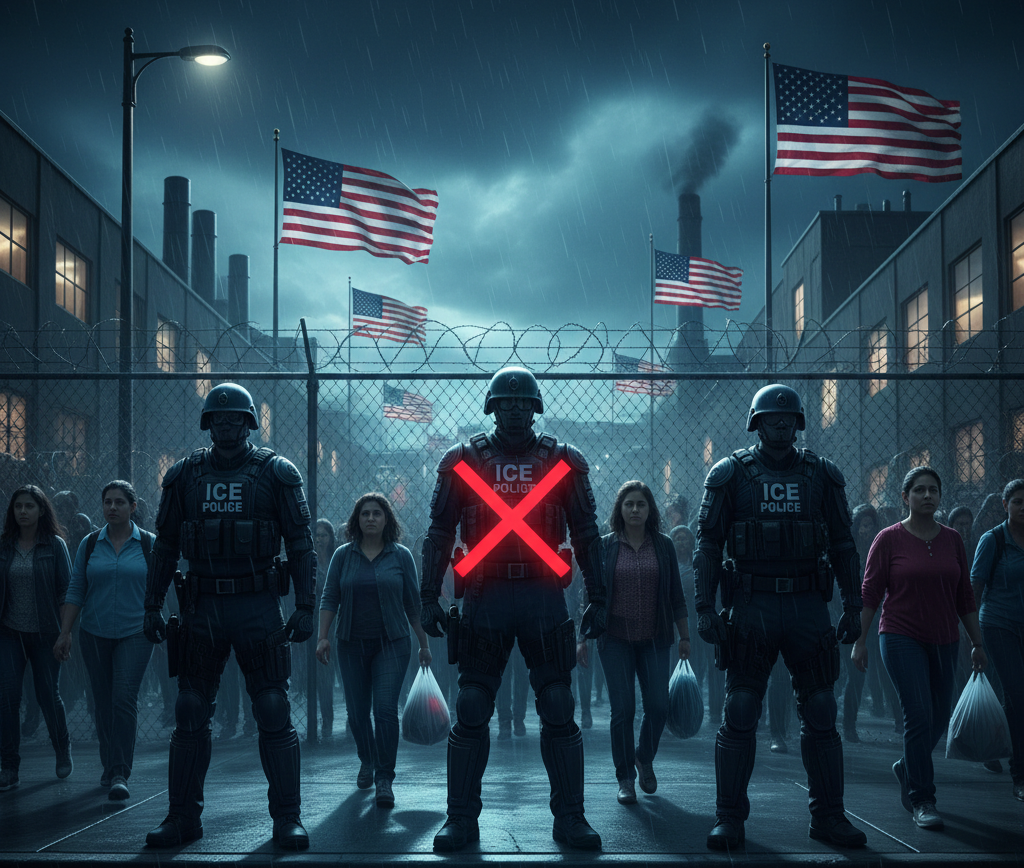
US immigration policies have been at the heart of American politics for the past few years.
They have sparked intense debate not only in terms of the economic effects, but also regarding the deep societal scars left by aggressive enforcement actions like the recent fatal shooting in Minneapolis.
Donald Trump has built a $170 billion enforcement machine that aims to reverse most of the immigration effects from the Biden era.
This massive financial pivot is now forcing the country to confront whether the pursuit of a closed border is worth the potential risk of a shrinking workforce and a stagnating US economy.
Why did the system break before
The current tension over immigration stems from a period between 2021 and 2024, when the American public felt they lost the keys to their own house.
During the Biden administration, border encounters reached historic highs because of a mix of global instability and specific policy choices.
Although the administration argued that economic collapses in places like Venezuela and Haiti were the primary drivers, critics pointed to the reversal of the Migrant Protection Protocols and the end of wall construction as signs that the door was left ajar.
The core issue for many voters was the feeling that their democratic will was being ignored.
They viewed the nation as an exclusive club where the members should decide who gets to join, but the 1967 UN Convention on the Status of Refugees created a loophole that allowed anyone crossing the border to stay for years while awaiting an asylum hearing.
By the time the Biden administration issued a restrictive executive order in June 2024 to curb these crossings, a deep sense of frustration had already settled across the country.
The billion dollar deportation machine
Since January 2025, the government has replaced the previous management style with an aggressive removal strategy.
The administration immediately shut down the CBP One app and cancelled hundreds of thousands of appointments that allowed migrants to enter for asylum hearings.
This move closed the primary bridge between illegal entry and legal processing.
To fund the new vision, Congress passed a massive spending package in July 2025 that gave ICE and the Border Patrol an additional $170 billion through 2029.
This is a staggering amount of money when you consider that their combined annual budgets used to sit around $19 billion.
About $45 billion of this new funding is going directly into detention centers, aiming to more than double the number of beds available for detainees.
While the government managed to deport about 622,000 people in 2025, the focus is now moving toward the American workplace.
Officials have confirmed that 2026 will see a surge in raids on farms and factories.
The goal is to remove the economic incentive for coming to the country, even if it means disrupting industries that rely heavily on foreign labor.
When enforcement meets the sidewalk
The transition from border enforcement to interior raids has changed how the public perceives the government.
In early 2025, many Americans supported the idea of mass deportation in theory. However, the reality of seeing masked federal agents in residential neighborhoods has caused a significant drop in approval.
A recent poll from YouGov showed that the net approval rating for ICE fell from a positive 16 to a negative 14 in just one year.
This change was accelerated by the fatal shooting on January 7, 2026, when an ICE agent killed a 37-year-old mother during an operation in Minneapolis.
While the government labeled the victim a threat, the public reaction was swift and negative.
Data now shows that 58% of Americans believe there is a state of conflict or war happening within their own cities.
This feeling is even stronger among older citizens who see the militarization of neighborhoods as a violation of basic rights.
For the first time, a plurality of the public approves of protests against the agency, and nearly 42% of people now support the once-fringe idea of abolishing ICE altogether.
A future with fewer hands
Beyond the political theater and the raids, a difficult mathematical reality is beginning to surface. The United States is facing a demographic squeeze that immigration used to solve.
The current fertility rate in America is roughly 1.6 children per woman, which is well below the 2.1 needed to keep the population from shrinking.
The administration has tried to fix this by offering $1,000 in Trump accounts for new babies and creating a national medal for motherhood.
These attempts have not changed the data, and similar programs in other countries have shown almost no success in raising birth rates.
If the goal of zero immigration is achieved, the American population will be 6% smaller by 2050 and could shrink by a third by the end of the century.
This means a smaller pool of workers will be forced to support a massive elderly population.
Currently, one in five Americans is over the age of 65, but that number will climb to one in three if the workforce continues to contract.
While the push for democratic control over the border has satisfied a desire for order, it has also created a scenario where the country is choosing to get smaller and older to maintain its sense of exclusivity.
The cost of the exclusive club
The focus on workplace raids in 2026 is intended to be the final blow to illegal migration, but it will likely be the moment the economy feels the most pain.
When the government targets the people who pick crops and work in construction, the cost of labor rises and translates into higher prices for everyone.
The administration is essentially betting that Americans will be willing to pay more for groceries and housing in exchange for the feeling of a closed and controlled border.
It is a trade between economic growth and national identity.
The government has also made legal immigration much more expensive, such as the $100,000 fee now required for certain high-skill visas.
These policies suggest that the era of using immigration as an engine for growth is over. The United States is prioritizing the rules of the club over the success of the business.
As the 2026 midterm elections approach, the public will have to decide if the visible and expensive enforcement on their streets is worth the quiet stagnation of the economy.
The real insight of the last year is that sovereignty is not free, and the bill is arriving in the form of higher prices and a divided sense of safety in American neighborhoods.
The post How Trump’s $170B immigration crackdown puts economy and workforce at risk appeared first on Invezz
