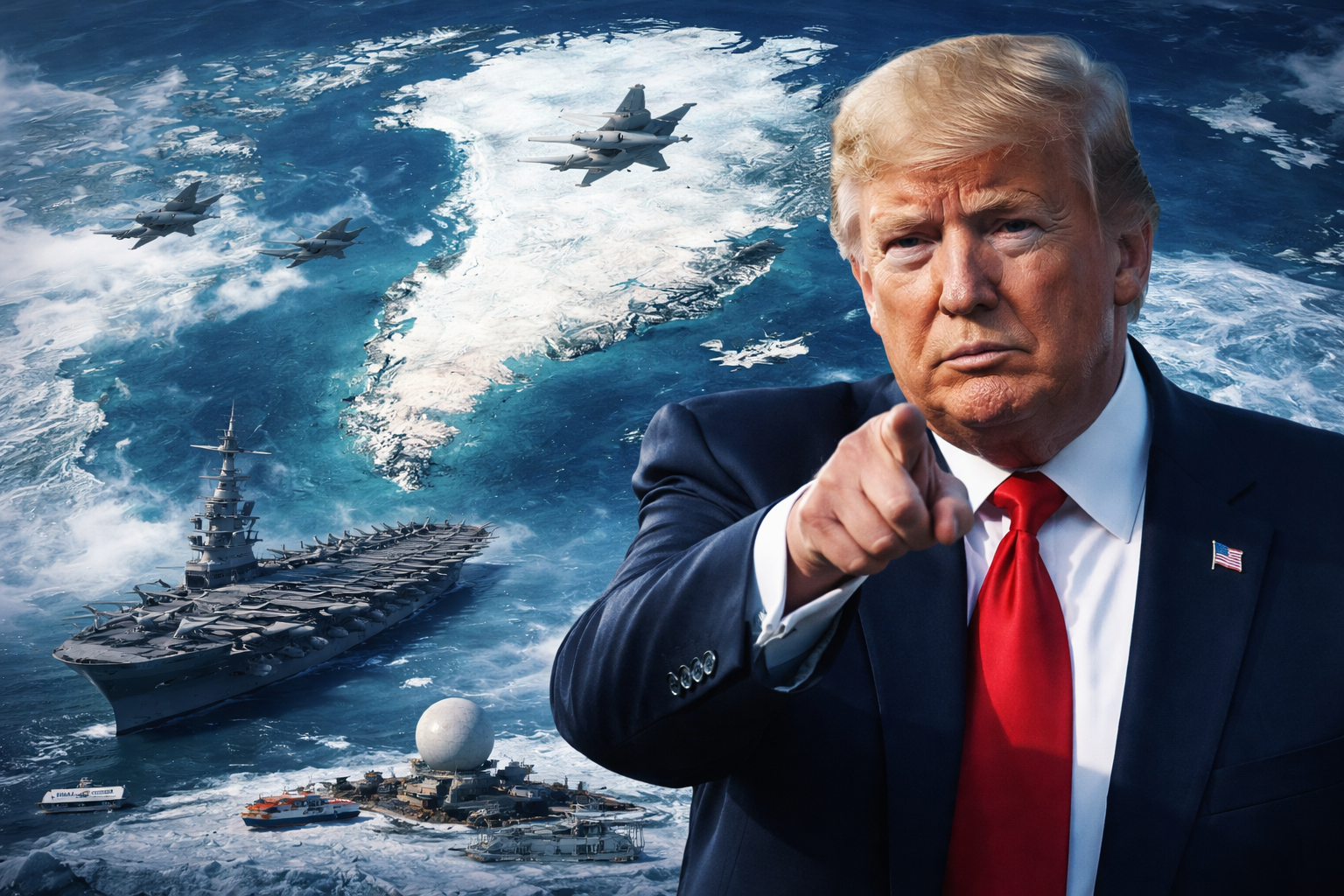
2026 began with intense geopolitical tension, and Trump’s new foreign policy strategy is at the center of it.
Following the capture of Maduro by US forces in Venezuela, Trump’s focus appeared to lurch northward once again. The US president revived his insistence that America “needs” Greenland and refused to rule out military force to secure it.
These events have triggered an unusually unified response from Europe and Canada.
The potential implications cannot be ignored, and no scenario can be ruled out, especially with how geopolitical events have escalated in recent years.
Why Trump “needs” Greenland
Greenland has always been treated as a strategic area. Its position between North America and Europe gives it military value that predates the Cold War. The United States already operates the Pituffik Space Base, a key site for missile warning and space surveillance.
NATO aircraft and ships use Greenland’s geography to monitor Russian movement through the North Atlantic. But none of this is new.
What has changed is the Arctic itself. Warming temperatures have extended operating seasons and improved access to waters that were once reliably frozen.
What makes this more important for the US is that Russia has rebuilt Soviet-era bases across its Arctic coast and China has invested in polar research, shipping concepts, and mineral supply chains.
On top of that, Greenland holds significant deposits of rare earths and other critical minerals that Western economies want to source outside China.
These are legitimate security and economic interests. They are also widely shared among NATO allies. That shared interest is precisely why the current dispute has alarmed Europe.
Greenland was already embedded in Western security planning, but it has now turned into an acquisition target.
Can Trump acquire Greenland legally?
Greenland is not a blank space on a map. It is a self-governing territory within the Kingdom of Denmark, with its own parliament and control over most domestic policy.
Denmark handles foreign affairs and defence, but Greenland’s political status is governed by a 2009 self-government law that explicitly recognises the Greenlandic people’s right to independence through a referendum.
What this means is that Denmark cannot sell Greenland even if it wanted to. Any transfer of sovereignty without Greenlandic consent would violate both Danish law and international norms.
That leaves only one legal route for any outside power seeking deeper control. Greenland must first choose independence, then decide its future partnerships.
US threats or pressure make that outcome less likely. Greenlandic politics has moved sharply toward unity since annexation talk resumed. Pro-US factions have lost ground.
Independence sentiment is rising, but on terms defined by sovereignty, not alignment with Washington. The louder the pressure, the harder the resistance.
NATO’s problem is not Greenland
European leaders reacted so forcefully because the issue goes beyond one island. Denmark, France, Germany, Britain, Italy, Spain, Poland, the Nordics, and Canada all delivered the same message: that Greenland belongs to its people, and Arctic security must be collective.
Their language was legalistic for a reason. Sovereignty, territorial integrity, and the inviolability of borders are not rhetorical flourishes. They are the foundation NATO rests on.
Joint Statement on Greenland
stm.dk/statsministeri…
The alliance has no mechanism to deal with coercion by its largest member against a smaller one. Article 5 is designed for external attack.
Even Article 4 consultations become strained when the perceived threat comes from inside the room.
Danish Prime Minister Mette Frederiksen gave a strong warning to the US, saying:
“But I also want to make it clear, that if the United States chooses to attack another NATO country militarily, then everything stops. That is, including our NATO and thus the security that has been provided since the end of the Second World War.”
That warning is based on the reality that trust is NATO’s main asset. Once allies start planning for security without the United States, the alliance becomes a shell.
Europe’s rapid coordination and Canada’s public alignment with Denmark show that this red line is widely understood.
What escalation would actually look like
If the United States were to use military force to escalate over Greenland, the most realistic outcome would be a coercive move short of outright invasion, framed by Washington as a defensive reinforcement of existing US facilities rather than an attack.
Denmark would immediately treat such action as a violation of its sovereignty and force the issue into NATO, triggering emergency consultations and exposing the alliance’s inability to respond coherently when one member coerces another.
Rather than bringing Greenland closer to the United States, the escalation would harden Greenlandic political opposition, collapse pro-US factions, and push both Nuuk and Copenhagen to restrict cooperation with Washington wherever legally possible.
The US would then face a set of unattractive choices. It could escalate further and effectively destroy NATO, hold its position and become diplomatically isolated from Europe, or retreat while suffering long-term damage to its credibility.
In all cases, the net effect would be strategic self-harm, weakening US influence in the Arctic and strengthening the hand of Russia and China without delivering control over Greenland or improving American security.
The misread at the heart of the crisis
The core mistake is not strategic ignorance. US planners understand the Arctic. The mistake is political.
Greenland is being treated as a strategic object rather than a political community with agency and legal rights. That approach misreads both Greenland and America’s own power.
The United States already has what it needs in Greenland from a military standpoint. Access, basing, and cooperation exist under long-standing agreements.
What it risks losing is consent. And in a system built on alliances, consent is the currency that matters most.
By framing Greenland as something to be acquired rather than a partner to be persuaded, Trump has triggered resistance that no amount of force can solve.
And the irony is that the only scenario in which the United States could legally deepen its role in Greenland runs through Greenlandic self-determination.
The post What happens if Trump tries to acquire Greenland? Risks for NATO appeared first on Invezz
