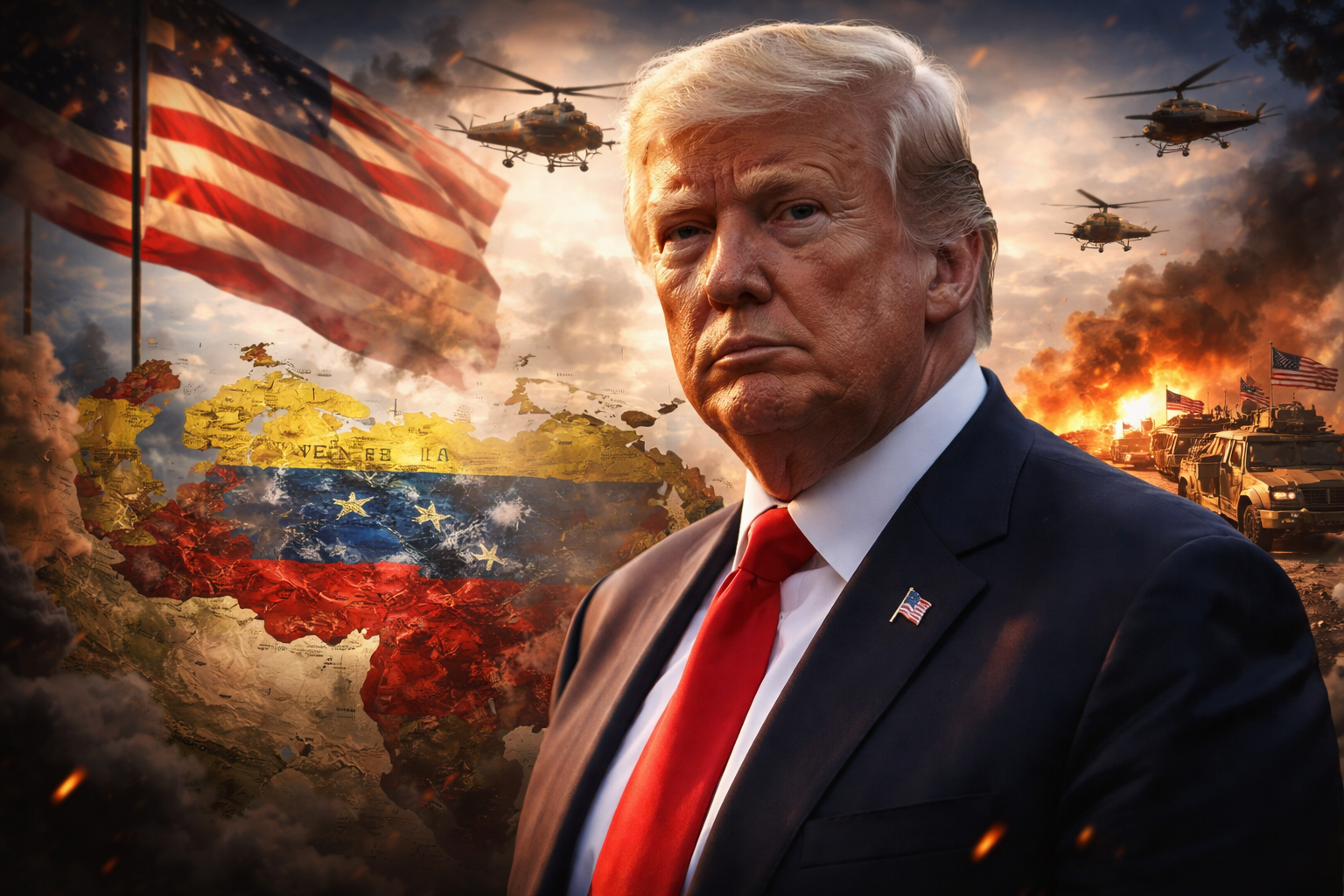
For a president who promised to be a peacemaker and wished for no more wars in 2026, Trump’s actions are doing the exact opposite.
The United States has removed a president and left the country suspended. Although Nicolás Maduro is in US custody, Venezuela is still being run by the same institutions that kept him in power.
Donald Trump has chosen an intervention that aims to control outcomes without formally taking responsibility for them, and Venezuela is the first full test of that idea.
Why Venezuela became the proving ground
Venezuela’s economy has been failing in slow motion for a few years now.
Oil output was collapsing, hyperinflation erasing incomes, public services were breaking down, and people were leaving the country at a rapid rate.
In fact, more than 7 million people have left the country since 2014. That migration has been felt across Latin America and inside US politics, especially in Florida and at the southern border.
Washington tried to pressure for years. Sanctions tightened, and diplomatic isolation deepened.
None of it dislodged the security and political elite around Maduro. That’s because sanctions hurt populations faster than they frighten regimes.
They create misery for the people, and not the regime exits.
The people who matter in an authoritarian system respond to threats to their survival and to deals that protect them if they switch sides.
Trump’s decision reflects that diagnosis. Venezuela was not chosen because it was the worst dictatorship in the world.
It was chosen because it was close, weak, isolated, and politically useful at home.
What the raid changed, and what it left untouched
The US operation succeeded at its narrow task. Maduro was captured and flown to New York.
But there was no attempt to dismantle the ruling party, disband the armed forces, or install the opposition.
Within hours, Vice President Delcy Rodríguez was granted acting presidential powers by Venezuela’s Supreme Court.
Trump said the United States would “run” Venezuela for now, but he also ruled out American troops or administrators on the ground.
Secretary of State Marco Rubio said Washington would judge the new leadership by actions. Trump warned that others in the Venezuelan hierarchy could face the same fate as Maduro if they resisted.
This is not regime change in the Iraq sense, but decapitation followed by coercion.
Remove the leader, freeze the structure, and force the remaining elites to choose between compliance and risk. The goal is to capture leverage.
That approach avoids the immediate costs of occupation. It also means the United States is betting on people it does not trust to deliver outcomes it wants.
The Rodríguez gamble
From the US perspective, Delcy Rodríguez is useful because she can keep the state functioning.
She knows the system. She has ties to the military and the bureaucracy. Installing the opposition immediately would almost certainly have triggered a backlash from armed actors who fear purges or prosecution.
The US appears to have chosen continuity first and reform later. That is a rational choice if the primary fear is collapse. It is also a fragile one.
Rodríguez is a product of the Maduro era. Her public survival depends on not appearing to serve Washington, while her private survival depends on not provoking the people who hold guns.
Any cooperation with the US must be quiet, partial, and reversible. That is not a recipe for clean outcomes.
The strategy assumes that fear will discipline the regime. Maduro’s arrest is meant to prove that no one is untouchable.
The problem is that fear also narrows options. Leaders under threat tend to hedge, delay, and preserve core power rather than transform it. Washington may get tactical concessions while the underlying system adapts and waits.
If Rodríguez fails to deliver, the United States faces a choice it has not yet confronted. Escalate and assume responsibility, or step back and accept limits.
Why Republicans rallied so quickly
The domestic response explains why Trump was willing to take the risk. The raid unified Republicans at a moment of internal strain.
Hawkish lawmakers praised the move as decisive. Party leaders framed it as a national security win. Isolationist critics were outnumbered and cautious.
Democrats attacked the lack of congressional authorization but avoided defending Maduro. That left them arguing the process while Trump claimed the results. In American politics, that asymmetry matters.
Foreign force compresses debate. It changes the subject. Inflation and governance fade when a president acts abroad.
With midterm elections approaching and Trump’s approval numbers under pressure, Venezuela reset the agenda.
This unity is real, but it is conditional. Fast interventions are easy to defend. Prolonged uncertainty is not. If Venezuela stabilizes, Trump keeps the benefit. If it unravels, the war powers fight returns with more force and more allies.
Trump’s new foreign policy strategy
Trump has not treated Venezuela as an exception, but as an example. His public language since the raid has been direct and consistent.
Power rests on control of territory, resources, and political outcomes. Multilateral approval is secondary, and allies are notified after decisions are made.
That framing is already traveling. Trump has openly speculated about applying pressure elsewhere, from Cuba to Colombia to Greenland.
He has warned governments in the Western Hemisphere that sovereignty is conditional on cooperation.
He has implied that force, sanctions, and economic leverage are interchangeable tools to be used as needed and without ceremony.
This is not a return to Cold War containment or post-9/11 interventionism, but it demonstrates a transactional model of dominance, where the United States allows nominal independence while asserting the right to intervene if outcomes drift out of line.
Critics argue this weakens international norms and lowers the bar for conflict elsewhere. Supporters counter that norms without enforcement invite defiance.
What is clear is that Venezuela has become the template. Other capitals are now recalculating not Trump’s words, but his willingness to act alone and then absorb the fallout.
The risk Trump is accepting
Trump’s bet is that he can extract compliance without ownership.
He wants Venezuela to stop exporting chaos, align with US demands, and remain governable, all without a visible American presence.
That is a coherent theory of power. It is also one that fails if the target state cannot produce a stable partner who can comply and survive.
History offers few examples where this works cleanly. Regimes under pressure often bend without breaking.
They concede enough to reduce risk and preserve control. That may be what Washington gets.
Trump appears comfortable with that uncertainty. He has already gained the political upside. The harder part comes later, when outcomes matter more than headlines.
Venezuela will not decide Trump’s legacy this week or this month. It will decide it by whether the system he left behind behaves like a state that has accepted American dominance, or one that is simply waiting for the moment when pressure eases.
The post How Venezuela marks the beginning of Trump’s new foreign policy strategy appeared first on Invezz
