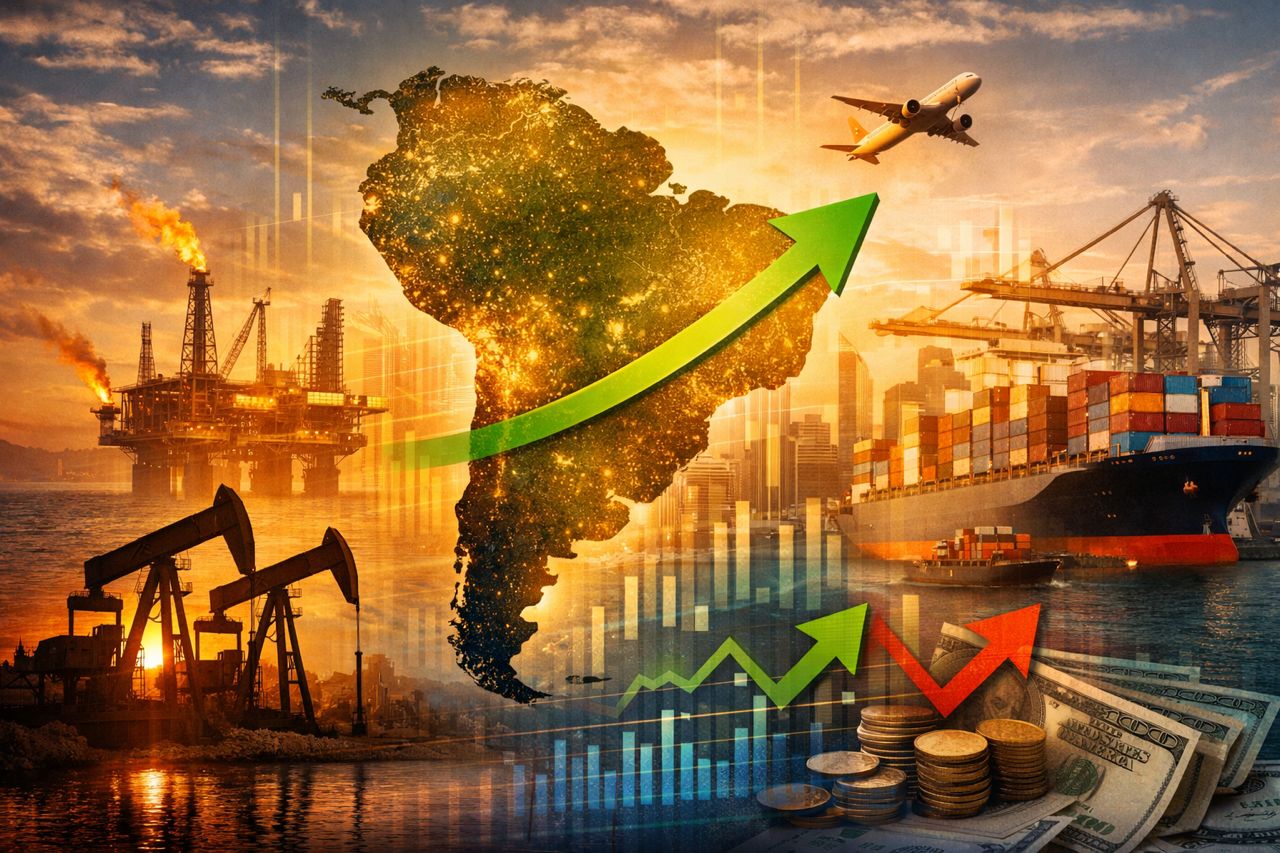
Latin America is heading toward a pivotal year in 2026 as new US tariffs and rising oil output reshape the region’s economic and energy outlook.
Analysts say a mix of relatively moderate trade barriers and expanding crude production could give some countries a competitive edge while creating headwinds for others.
Alejandro Grisanti, chief economist at Ecoanalítica in the Dominican Republic, told Invezz that the uneven tariff regime is already producing clear winners and losers.
“Most Latin American countries saw just a 10% increase in tariffs, particularly across Central America and the Caribbean, with exceptions like Nicaragua,” Grisanti said.
By raising tariffs more heavily elsewhere, nations with lesser increases, such as the Dominican Republic, gain a comparative advantage over European exporters facing higher levies.
Not all economies are positioned to benefit. Mexico faces tariffs of as much as 25%, while Brazil is confronting increases of about 50%, a combination that risks weighing on trade with the US.
Venezuela, Bolivia and Nicaragua have seen tariff increases of roughly 15%, reflecting a blend of economic and political considerations.
Grisanti said negotiations remain ongoing and expects tariffs to settle in a 10%–15% range for most of Latin America, a level he described as a net positive for the region.
Tariff landscape: less impact than forecast
In 2025, the US pressed ahead with a policy agenda that imposed broad-based tariff increases on imports from Latin America and the Caribbean.
While early consensus forecasts pointed to a sharp near-term contraction in trade, subsequent data showed export growth continued, supported by resilient demand and pricing dynamics.
Trade between Latin America and the Caribbean was on track to keep expanding in 2025 despite the new US tariff regime, with values forecast to rise by about 5%, up from 4.5% in 2024, according to a November 2025 report from the United Nations Economic Commission for Latin America and the Caribbean, cited by Reuters.
The increase was driven largely by a 4% rise in export volumes and a modest gain in net prices.
The immediate impact of higher tariffs proved less disruptive than expected, the report said, as US companies accelerated imports and built inventories ahead of enforcement, while trade with Asian markets remained robust.
ECLAC’s air transport data also showed that exports from Latin America and the Caribbean face an average effective US tariff of around 10%, roughly seven percentage points below the global average, a gap that helped soften the blow to trade flows.
Latin America emerges as an oil growth hub
Beyond trade, Latin America is set to become the world’s main source of oil supply growth in 2026, reshaping global energy markets and challenging traditional producers.
Oxford Economics estimates the region will add about 1.6 million barrels a day of new output, making it the largest contributor to incremental supply outside OPEC+.
Brazil is driving much of that growth, led by Petrobras’ pre-salt offshore developments, with total production projected to reach 5.5 million barrels a day.
Guyana is also expanding rapidly through the ExxonMobil-led Stabroek Block, positioning the country as a significant new entrant in global oil markets.
Argentina is adding supply through efficiency gains in Vaca Muerta, strengthening South America’s role as a producer of medium- and light-grade crude.
Mexico, by contrast, along with several other countries, is seeing output stagnate or grow only marginally due to mature fields, weak investment and regulatory constraints.
Global context
Globally, US oil production is expected to rise more slowly, adding about 400,000 barrels a day, largely through productivity gains in shale.
OPEC+ members, including Saudi Arabia and the UAE, are projected to add around 1 million barrels a day by mid-2026. Russian output is expected to stabilise before declining as sanctions and technical limits take effect.
The combined increase in global supply is expected to weigh on prices.
Oxford Economics forecasts Brent crude will fall to $58 a barrel by late 2026 and to $55 in 2027, assuming disciplined OPEC+ output and capital restraint among US shale producers.
Implications for Latin America
The combination of moderate tariffs and rising energy production could give several Latin American economies a strategic advantage.
The Dominican Republic, for example, benefits from limited tariff increases that improve its competitiveness relative to European exporters.
Brazil and Guyana stand to gain from higher oil revenues and rising geopolitical relevance as reliable suppliers, while Argentina’s steady output growth adds resilience at the regional level. Mexico and Brazil, however, face tougher conditions due to higher tariffs and domestic political challenges.
Grisanti said the uneven impact of tariffs could redirect trade and investment flows.
By raising costs globally but unevenly, some economies gain a relative benefit. If tariffs stabilise at moderate levels for most Latin American countries, the region as a whole stands to gain in trade and energy.
Outlook for 2026
Latin America enters 2026 facing both opportunity and risk. Rising oil output is boosting revenues and global influence, while carefully managed trade relationships are giving select countries a competitive edge.
Policymakers and investors will be watching US trade talks, energy-sector expansion and geopolitical shifts closely.
If current trends persist, the region could emerge as both a major energy supplier and a more competitive force in global trade.
Countries that successfully align energy growth with strategic trade policies may gain lasting advantages, marking a potential turning point in Latin America’s economic trajectory.
That intersection is reflected in the 2026 outlook. The combination of moderate US tariffs and surging oil production led by Brazil, Guyana and Argentina creates a window for growth.
Grisanti said countries able to adapt to these shifts have an opportunity to reposition themselves within global trade and energy markets.
With careful planning, 2026 could mark a decisive step toward Latin America becoming a global energy hub and a more competitive trading region.
The post Why 2026 could be a defining year for Latin America’s trade and energy markets appeared first on Invezz
