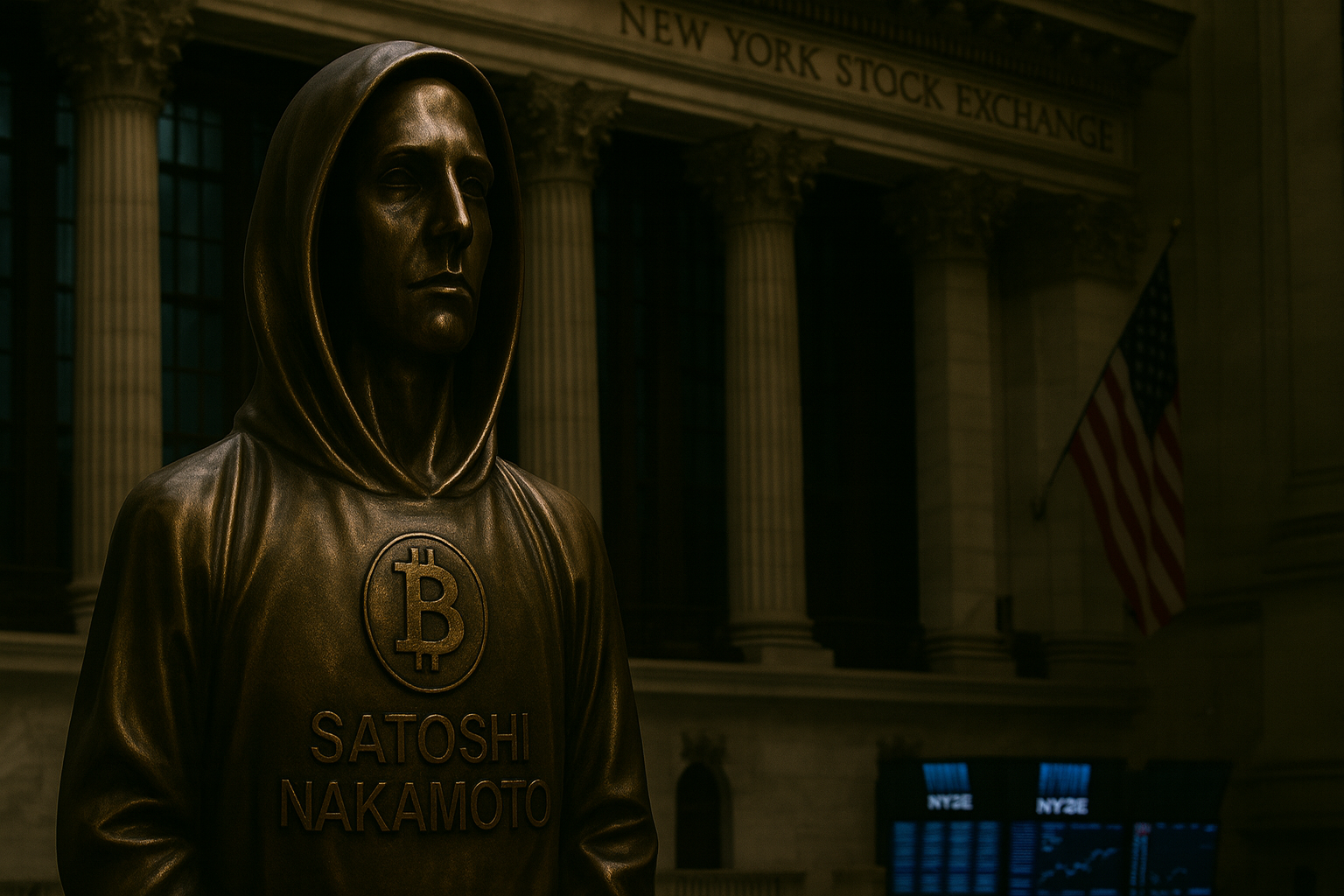
A bronze statue of Bitcoin’s mysterious creator, Satoshi Nakamoto, now stands in the heart of the New York Stock Exchange, underscoring how mainstream financial institutions are increasingly recognising cryptocurrency’s significance.
The installation, organised by Bitcoin firm Twenty One Capital, is the sixth of 21 planned monuments and signals Bitcoin’s journey from niche digital experiment to influential force in global finance and culture.
The Satoshi Nakamoto statue
The statue, created by Italian artist Valentina Picozzi, is part of her “disappearing Satoshi” series, which portrays the anonymous inventor as a seated figure with a laptop, fading into the surroundings.
Picozzi, who operates under the Satoshigallery handle, described seeing her work installed at the NYSE as “mind-blowing” and “beyond our wildest dreams,” emphasising the symbolic significance of merging emerging digital systems with traditional financial institutions.
NYSE officials echoed this sentiment, calling the placement “shared ground between emerging systems and established institutions.”
“Satoshi Nakamoto”
Valentina Picozzi – @satoshigallery
Twenty One Capital places a statue of Satoshi Nakamoto, the inventor of bitcoin, in NYSE. Its new home marks a shared ground between emerging systems and established institutions. From code to culture, the placement
The timing of the unveiling is particularly poignant, coinciding with the anniversary of the Bitcoin mailing list, which Nakamoto launched on December 10, 2008.
Nakamoto mined the first Bitcoin block on January 3, 2009, creating the foundation for the first decentralised payment system.
In 2010, Laszlo Hanyecz completed the first documented purchase with Bitcoin, spending 10,000 BTC on two pizzas.
These milestones illustrate the journey from Bitcoin’s experimental origins to its current status as an institutional asset.
21 statues scheduled for installation across the world
Picozzi’s global statue campaign draws attention to Bitcoin’s capped supply of 21 million coins, with six of the planned 21 installations now completed, including locations in Switzerland, El Salvador, Japan, Vietnam, and Miami.
The series embodies both the technological and cultural dimensions of Bitcoin, portraying Satoshi as an enigmatic figure whose work persists in code rather than in person.
Earlier installations, such as the original in Budapest, feature a mirrored, faceless design representing the philosophy of “we are all Satoshi,” while Picozzi’s disappearing design emphasises the subtle presence of the inventor behind the innovation.
The initiative has, however, faced challenges, including vandalism in Switzerland, where one statue was stolen and dumped into Lake Lugano, yet the campaign continues to advance.
Picozzi intends to complete all 21 monuments, creating a worldwide network that memorialises Bitcoin’s history while highlighting the creativity and ingenuity of the developers who built the ecosystem.
Twenty One Capital’s involvement
Twenty One Capital, which recently began trading publicly on the NYSE under the ticker XXI, orchestrated the installation as part of a broader effort to solidify its presence in the corporate Bitcoin ecosystem.
The company holds approximately 43,500 Bitcoins, valued at nearly $3.9 billion, making it one of the largest corporate holders globally.
Despite this, Twenty One’s shares opened below expectations, with the stock falling roughly 19% on its trading debut following a blank-check merger.
CEO Jack Mallers, who also founded the Lightning Network payment provider Strike, emphasised that the firm aims to offer services beyond simply accumulating Bitcoin and does not trade at a premium to net asset value, setting it apart from other digital asset treasury companies.
The statue also highlights Bitcoin’s growing acceptance on Wall Street, where public companies, private firms, countries, and exchange-traded funds now collectively hold more than 3.7 million BTC, worth over $336 billion.
Institutions that were once sceptical, including major financial executives like BlackRock CEO Larry Fink, have increasingly embraced the asset class, using ETFs and corporate treasuries as vehicles for participation.
This institutional interest reflects a broader shift in perception, moving cryptocurrency from regulatory scepticism and market taboo toward mainstream recognition.
The post Twenty One Capital facilitates installation of Satoshi Nakamoto statue at NYSE appeared first on Invezz
