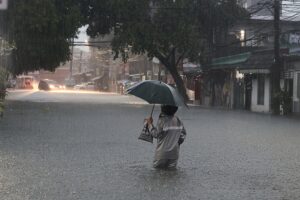
SOUTHEAST ASIA is facing rapidly rising exposure to severe flooding as climate change accelerates, and populations expand in vulnerable areas, according to a study by BMI, a unit of Fitch Solutions.
BMI said the region is increasingly experiencing “compound disasters,” or extreme weather events that occur in close succession, which strain response systems.
BMI reported that Southeast Asia’s exposure to high-intensity flood risk remains among the highest globally.
About 20% of the population in Indonesia and Malaysia lives in areas that face significant flood threats. In the Philippines, Vietnam, Sri Lanka and Singapore, the percentage is between 14% and 15%.
BMI reported that the share of Filipinos living in high-intensity flood-risk zones increased by almost two percentage points, equivalent to about one million people, between 2020 and 2024 compared with the previous decade.
According to BMI, transportation and agriculture are among the industries most severely affected by climate change in Southeast Asia.
“Many airports, roads, and railways lie in or near areas that are frequently flooded, leading to disruption. Croplands are also increasingly flooded, with the impact of floods, exacerbated by deforestation, which leads to soil erosion and landslides,” BMI said.
Meanwhile, BMI said disaster resilience of emerging Asian markets will continue to improve, but will not be keep pace with those of developed markets in the region.
Improvements also vary by country, with China, India, and Thailand seeing the biggest gains from 2023 to 2025. The Philippines’ resilience score in the same period remains largely unchanged at around 45 out of 100, with 100 representing the weakest resilience.
An earlier BMI report in September found that the Philippines’ flood mitigation measures remain inadequate. BMI said the country has been underspending on flood management, and recent revelations of rampant corruption suggest it has underspent more than previously thought.
“Climate change is increasing the frequency and severity of flooding and adverse weather events, and the inadequate flood control infrastructure in the Philippines will weigh on its long-term growth trajectory,” BMI said.
By comparison, complex, integrated flood defenses in countries like Japan and Singapore are expected to continue proving effective at preventing floods in the coming decades.
Citing a study by the Japan International Cooperation Agency, BMI said the Philippines will need to spend an average of $3.9 billion per year from 2016 to 2030 to meet demand for flood control infrastructure that would produce $12.6 billion in net benefits by 2030. — Vonn Andrei E. Villamiel
